Index / Research / Chartour I
CHARTOUR I
On the Green Man of The Howff
This Chartour records a foliate carving whose origins remain uncertain and considers its endurance across demolition, relocation and civic transformation.
The Green Man Stone
A carved stone depicting a foliate head, commonly described as a “Green Man”, now stands within The Howff burial ground in Dundee. The sculpture consists of a human face entwined with foliage, branches issuing from the mouth and features, consistent with the medieval foliate head motif found across Britain.
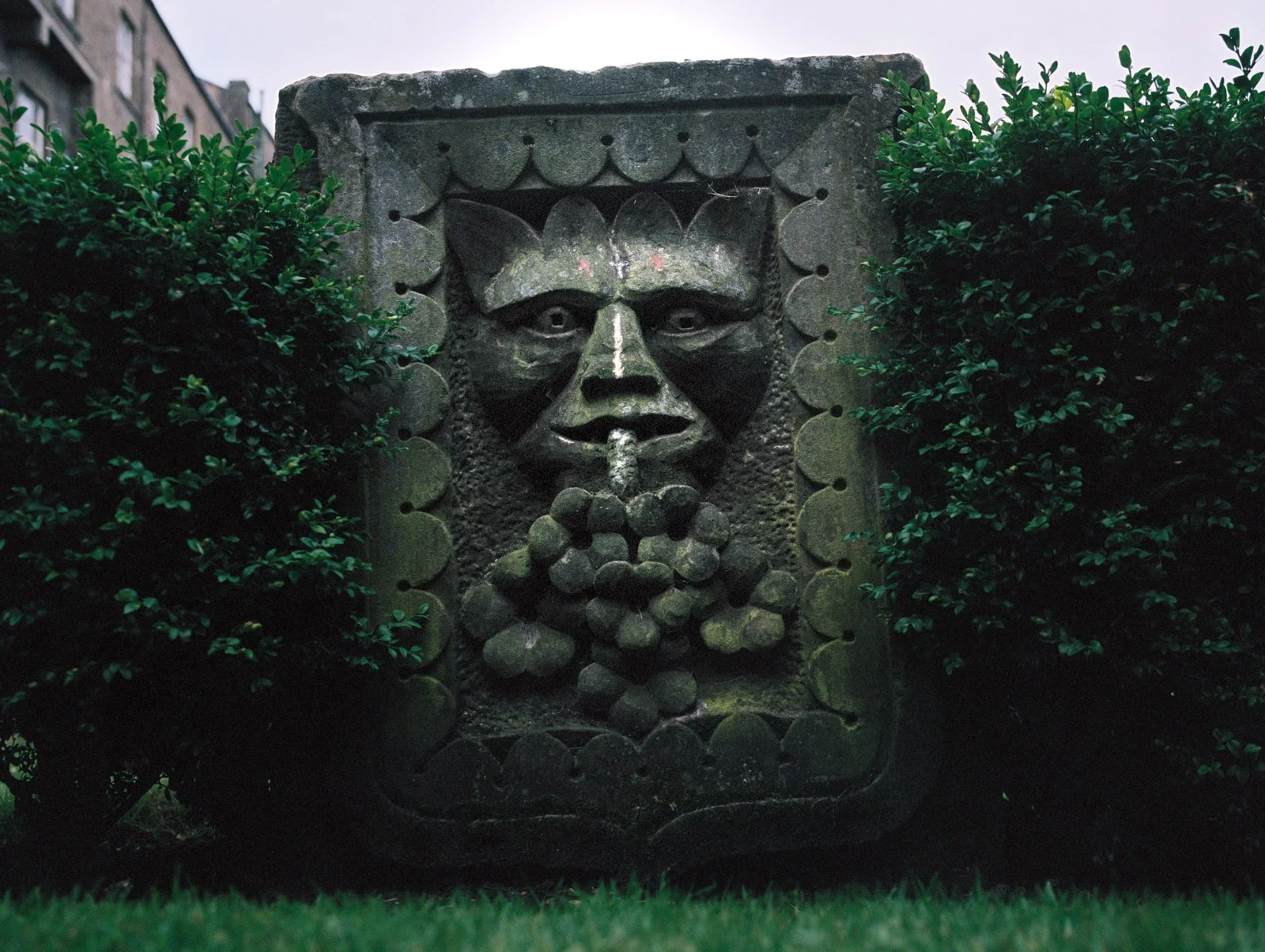
Fig. I. - Green Man stone, The Howff, Dundee. Photograph by Fort Dee.
Archival Account
Documentary references place the stone at 5-7 Ann Street, where it was inset into a tenement building. The building suffered a fire in the 1960s and the carving was salvaged prior to demolition and retained in storage by Dundee City Council. Subsequent research undertaken by the Nine Trades of Dundee suggests that the stone may have been salvaged from a medieval structure during the clearance of central Dundee under the Police and Improvements Act of 1871.
If this account is accurate, the carving was displaced from an earlier building, re-set into nineteenth-century flats on Ann Street, removed again during redevelopment and eventually installed within The Howff, where it remains visible to the public.
The stone’s precise medieval origin remains unknown.
Displacement and Survival
The Green Man motif is often retrospectively associated with themes of fertility and renewal, the face enveloped or issuing foliage as an emblem of seasonal return. In this instance, however, the stone’s own material history becomes inseparable from that symbolism.
The carving has survived not through stability, but from displacement. Removed from its original context, re-embedded within later architecture, extracted once more and placed within a burial ground, it has endured successive cycles of erasure and preservation.
Its continuity is not from being rooted in a fixed location, but in repeated acts of recovery.
Civic Transformation
The demolition of medieval Dundee in the nineteenth century and the subsequent redevelopment of Ann Street in the twentieth, form part of the city’s longer narrative of reinvention. Industrial expansion, post-industrial decline and contemporary regeneration initiatives have reshaped the urban fabric repeatedly.
Within this shifting landscape, the Green Man persists.
Its presence within The Howff, itself a site of layered time, positions it not merely as ornament but as witness.
Recurrence
The foliate face, composed of growth emerging from stone, is frequently read as a symbol of regeneration. Whether or not this interpretation reflects medieval intention, the carving’s survival through demolition and redevelopment renders the metaphor materially legible.
The Green man does not simply represent renewal; it has been repeatedly renewed through human intervention.